
- Awards & Recognitions
Medical-engineering student team wins third place at Bright SCIdea Challenge 2026 in UK
April 27, 2026
A student team from Science Tokyo has finished third in an international entrepreneurial competition for pitching a digital tool to help epilepsy patients sustain ketogenic diet therapy.
Thirty-two university student teams from around the world took part in the Bright SCIdea Challenge 2026, a competition to develop an innovative science-based idea into a business plan, on March 17. The event was hosted by the Society of Chemical Industry (SCI) and sponsored by chemical and biotech companies such as Synthomer and Sterling. The finalists won a cash prize to help facilitate the commercialization of scientific ideas aimed at solving societal issues.
Team MediKeto from Science Tokyo was one of six finalists to compete in London following the judging process. Third-year medical students Yuri Fujikura and Eleina Hames, as well as Nano Kojima, a first-year doctoral student in Transdisciplinary Science and Engineering, were commended for their achievements in the competition.
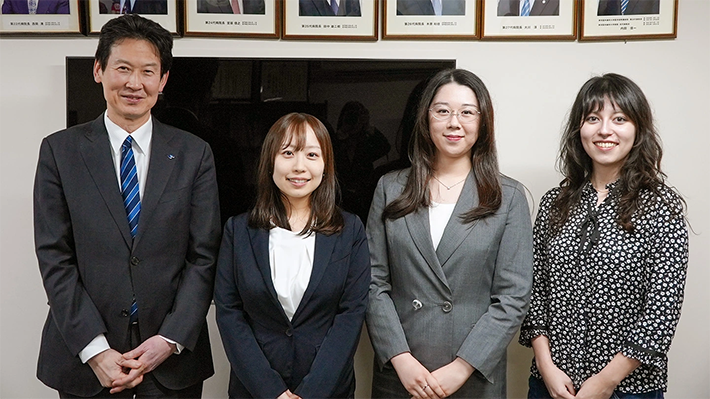
The team’s collaboration began after an outreach message on the university’s Slack. Members from different specialties came together, pooling their expertise to launch this project.
Team MediKeto’s dietary support healthcare app
The ketogenic diet is a specialized high-fat, low-carbohydrate diet regimen aimed at increasing ketone bodies which serve as an energy source for the brain. Because the diet has been shown to suppress seizures in patients with intractable epilepsy, it is covered by health insurance. However, this diet can be very difficult to maintain in daily life.
Team MediKeto is developing a diet support healthcare app designed to assist such patients. Specifically, the app allows patients and their families to easily record and manage their daily meals, and includes functions such as automatic ketone ratio calculation, guidance on necessary nutritional balance, and meal plan suggestions. By combining medical expertise with a dynamic student-led medical engineering approach, Team MediKeto aims to commercialize their idea as a digital tool that supports ongoing treatment and creates a precedent for more digital health solutions from Science Tokyo.
Finals in London
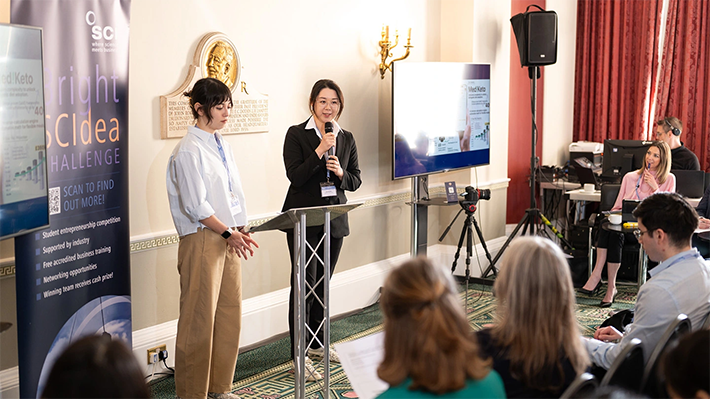
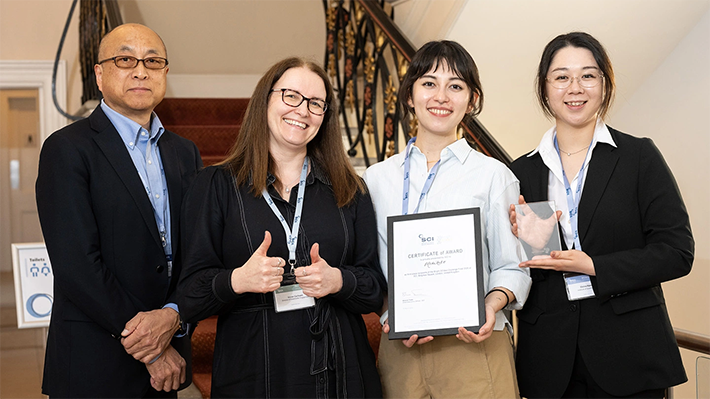
At the final competition in London, finalists from around the world took the stage to present their research and business plans followed by an intense Q&A session with the judges and audience. Team MediKeto kickstarted the event with the first to pitch and won third place. They were commended for their practical proposal rooted in real-world clinical challenges and the high feasibility of their approach, which integrates medicine and engineering.
Comment from Kojima
We did not win the contest, but we were proud to secure third place in the judges’ vote and second place in the audience vote. We believe this reflects the strength of our project’s purpose — one that resonated with a wide audience — as well as our ability to communicate it effectively when it mattered most.
In developing an app as a communication medium connecting people across different fields, such as healthcare professionals, patients, their families, and researchers, I feel that I have been able to draw fully on what I learned in the Xinru Zhu and the Kayoko Nohara Laboratories at the School of Environment and Society.
Looking ahead, we hope to continue leveraging our strengths: integrating clinical practice and research, drawing on expertise across related fields, and developing software that combines accessibility, intuitive design, and ease of use. Through this, we aim to create solutions that support the everyday lives of intractable epilepsy patients and their families.
Finally, as someone living with epilepsy, I am genuinely grateful that a project like this exists, that I contributed to it as an engineer, and that we were able to achieve meaningful results in this competition. I would like to take this opportunity to once again express my sincere gratitude to the team and to everyone who supported us.
Medical-engineering creations from Science Tokyo to the world
Science Tokyo continues to promote initiatives that integrate knowledge from diverse fields such as the medical and dental sciences, and science and engineering, to contribute to solving societal challenges.
The achievements of Science Tokyo’s members at Bright SCIdea Challenge 2026 not only demonstrate the potential of medical-engineering collaboration, but also showcase the success of the Institute’s young researchers on the international stage.
*Reprinted (excerpted) from the “Science Tokyo News” section of the university website.
(Reprinted from the following site)
https://www.isct.ac.jp/ja/news/8o17grt8bm8s